January Gardening Calendar

Standard

photo (84)

On or near the beginning of each month I will present a gardening calendar.  I find that it saves time and worry if I have a ready-made plan for activities in the garden.  January is one of the least busy months of the year for gardeners, but we have a few things that need to be or can be done:

Plan your garden for the year.  Read seed and nursery catalogs and pick out what you would like to grow.  It is a good idea to plant greater numbers of the vegetables and fruits your family uses on a regular basis.  Minimize or eliminate the things you do not.  Figure out how much space you have and how much seed you need, then order.  If you are just beginning or reconfiguring your garden, January is a great time to undertake design projects.  January is also an excellent time to repair equipment, such as garden tools, plant supports and cold frames.

If you have a supply of fresh manure you can make a hotbed in which to grow early vegetables and flowers.  Though perhaps unpleasant to deal with, a hotbed provides a little microclimate that is much warmer and more humid than the out of doors.  Hotbeds will extend your growing and harvest seasons.  They are a real help in climates with short seasons and cool nights.  Squash, melons, peppers and eggplant enjoy the warm nights a hotbed will provide, thereby significantly increasing production.  In the nineteenth century most winter vegetables, such as cauliflower, were grown in hotbeds.

Carefully tend your cold frames in January, covering them with insulating materials on cold nights and admitting air during the day if it is not too cold.  Now is the time to clean debris and dead leaves out of winter lettuces and other greens in cold frames or cold greenhouses.

Early cabbage can be sown indoors, as well as parsley, cauliflower and eggplant.  Flowers to sow inside to transplant out later include: geraniums, impatiens, lobelia, petunias, pansies, snapdragons and violas.  Primroses, auriculas, delphinium and many other perennials can be sown now indoors.

Manure can be spread over vegetable beds and perennial borders.  Pruning can begin of fruit trees and raspberries.  If you live in a mild climate or have a large cold frame or cold greenhouse, you can harvest any of the following: leeks, spinach, kale, carrots, lettuce, corn salad, onions, parsnips and chard.  In a cold climate carrots and parsnips outside can be covered with straw to protect them, so you just have to push away the snow and straw to dig them.  In a cold (unheated) greenhouse greens can be grown and harvested all winter, especially if an inner layer of floating row cover is placed over the crops to protect them.  Stakes or hoops will prevent the fabric from touching the leaves of the plants.

Enjoy January!
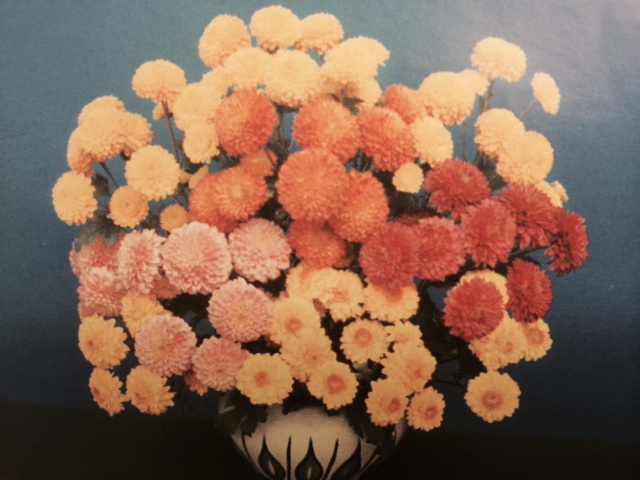


Antique Chrysanthemums

Standard

photo (83)

More than 150 species of Chrysanthemum exist in nature.  In this article we are concerned with Asian species brought to Europe and North America as garden plants.  In ancient China gardeners selected interesting plants from the wild and over centuries developed chrysanthemums into popular garden plants.  A yellow garden variety and a white were known in China by the fifth century B.C.  By 1,000 A.D., in the time of the refined Sung dynasty, thirty-five named varieties of mums existed.  By 1700, the number had jumped to 300.

The florist chrysanthemums we grow today in America (and all over the world) are descended from wild and garden plants introduced from China.  The first species to reach Europe was Chrysanthemum morifolium, ancestor of modern florist mums.  Plants arrived in Marseilles, France in the 1780s, then were brought to England by 1790.  The flowers of this species are purple.  After 1800 more garden varieties arrived in Europe and America from China.  The yellow-flowered C. indicum arrived in England in the early nineteenth century.  Enthusiasts soon crossed C. morifolium x C. indicum to create a wide range of colors and shapes.  (It is not known how many of the diverse forms that appeared in the early 1800s were new hybrids; some may have been garden varieties received directly from China.)  By 1834 fifty varieties in several colors and shapes were available in Europe and America.

Robert Fortune introduced another Chinese species, C. rubellum, the Chusan Daisy, in 1846.  The advantage of this species and several of its hybrids is that it endures colder temperatures than the other two species.  The plants tend to be shorter, also.  The picture above (from The Cottage Garden, by Roy Genders, Pelham Books, 1969) shows several blooms of C. rubellum.  Because of the button-like shape of the flower this kind of mum came to be known as the “Pompon chrysanthemum”.   The pompon class is still recognized today by the National Chrysanthemum Society.

I once grew a beautiful pompon mum named ‘Paul Boissier’, but lost it in a move.  It grows to about three feet or more and has beautiful, double orange and bronze flowers in the lovely circular shape of the pompon mums.  Few heirloom mums survive today, and only a very few are commercially available.  Shirley Hibberd, in his book The Amateur’s Flower Garden, published in 1871, listed 100 named cultivars of chrysanthemum.  None of them is available from a nursery today!  It is probable that if some of these old named plants do still exist, they would have to be re-identified.  I am always looking for old mums, especially pompons, but have not had much success.

Today the National Chrysanthemum Society recognizes thirteen distinct classes of mums, defined by their flower shapes.  Emphasis seems to be on contemporary varieties, not on heirloom mums, but membership does expose one to the great diversity of modern mums available.  Membership is only $20.00 per year for an individual.  Youth memberships (under 17), garden club affiliation (organization) memberships, and life memberships are also available.   The website for the society is mums.org.  Two benefits of membership are a cultural manual for new members and a quarterly journal.  Why not join and voice a desire to locate, preserve and propagate antique chrysanthemums?