SEPTEMBER GARDENING CALENDAR

Standard

IMG_0667

SEPTEMBER GARDENING CALENDAR

GENERAL

Harvest beans and other crops; remove blossoms from eggplant and peppers to ripen remaining fruits.  Cover sunflowers from birds, pinch tomato tips.  Lay down grass turf.  Watch for slugs and snails, cultivate to destroy grasshopper eggs.  Also, watch for corn earworms.

VEGETABLES

Cultivate or hoe around cabbage, cauliflower, broccoli, turnips and celery.  Keep late maturing cauliflower and broccoli well-watered.  Transplant out starts of endive the first week of September.  Plant garlic and shallots and over-wintering onion sets.  Direct seed outside: arugula, lettuce, radishes, cress, corn salad, chervil and kale.

If you plan to grow crops under tunnels or in a cold greenhouse over the winter, plant seed (early in the month) of crops for winter use: chervil, kale, spinach, lettuce, radishes, corn salad, and winter cress.  Later in the month, from the 20th to the first week of October, plant seeds of cabbage, cauliflower and other brassicas for transplanting out into tunnels in OctoberHave winter cover ready by October 1.

Make beds for growing mushrooms.  Well-rotted horse manure is excellent for mushroom beds.

Gather ripe seeds of any vegetables (or flowers) you want to save seed from.

Watch outdoor temperatures and bring in house plants if frost threatens.

FLOWERS

Prepare beds for planting bulbs.  Sow seeds of bulbous flowers collected in summer.  Take cuttings of violets and pansies; plant cuttings out in early spring.  Transplant peonies and lilies.  Dig dahlias after killing frost.  Transplant pinks and carnations with root ball intact late in the month.  Late in the month, plant out perennials and biennials where they are to bloom.  Also, most perennials can be divided now and replanted where they are to bloom.


FRUIT

Gather ripe fruit from apples and pears.  Remove diseased fruits and “mummies”, rake up leaves under fruit trees and destroy them (to prevent apple scab).  Prepare equipment to make cider.  Finish budding apples.  Prepare beds for planting fruit trees, using well-rotted manure, digging down 18 inches.  Take cuttings or make layers of gooseberries, currants, honeysuckle, and other trees and shrubs.  Plant seeds of fruit trees: cherry, plum, apricot, apple, pear, etc.

Keep strawberries free of weeds and the soil moist.  If you plan to force strawberries in winter, now is the time to take them up and pot them.  Cut a root ball out with a knife, trim off dead leaves and runners and pot into 7 or 8 inch pots.  Place them in shade and water well.  Then plunge the pots in earth up to the rim.  Take them up and into frames or greenhouse before cold weather.

Protect ripening grapes from birds with netting or gauze; keep weeds away from plants.  If wasps are a problem, hang containers of sugar water to catch them.  Prepare to make wine if desired.

TREES, SHRUBS AND ROSES

Trim branches of evergreens and walnut trees, so wounds will heal before winter.  Keep weeds cleaned out from nursery beds and plantings of young trees.
 

SOIL PH FOR GROWING VEGETABLES

Standard

FullSizeRender


Soil pH is a measure of acidity or alkalinity.  This measurement can range from a very low pH of 1.0 to an extremely high pH of 14.0.  7.0 is considered neutral and several vegetables will thrive in soil with a neutral pH.  Some vegetables do prefer a more acidic soil while others prefer a more alkaline soil.  Fortunately most will grow and produce well in a pH range of 5.5 to 7.5.   Areas with high rainfall, such as coastal Washington, tend to have acidic soils high in organic matter, while areas with lower rainfall, such as most of the mountain valleys in Montana, tend to have alkaline soils low in organic matter.  Here in the valleys of the Flathead region, where most of us garden, soils tend to be somewhat to highly alkaline.

Before you amend your existing soil to plant vegetables it is a good idea to test the pH.  An easy way is to purchase a test kit.  Most of them are easy to use and give fairly accurate readings.  Your county extension agent can do a soil test also.  Once you have determined your soil pH and which crops you intend to grow, you can amend your garden soil.  Adding lime will increase pH and make acidic soils more alkaline; adding sulfur will lower pH and make soils more acidic.  Organic matter usually helps reduce alkalinity.  Aged manure, pine needles, compost and coir dust are a few amendments that will help do this while they improve soil structure and encourage beneficial soil micro-organisms.  If your garden is divided into separate beds or raised beds, it is easier to adjust the soil in each bed for what you plan to grow.   I rotate my vegetable crops in a four-year rotation plan, so I try to keep a basic soil pH around 6.0 to 6.5.  This way I can grow almost every vegetable, but I slightly adjust pH each year before growing a particular plant.  For example, I add sulfur before growing potatoes.  Conversely, I add a small amount of lime before planting any of the Brassica family (Broccoli, Brussels sprouts, cauliflower, etc.).   Having soil pH correct for each crop will reduce pest and disease problems as well as increase yields.

Here is a listing of pH tolerance ranges for specific vegetables.  (The optimum pH for each is usually the median between the two extremes.)  I have listed vegetables preferring more acidic soils first and those preferring more alkaline soils last:

Potatoes, 4.5-6.0; sweet potatoes, 5.6-6.5; horseradish and rhubarb, 5.5-6.8; butternut squash, carrots, corn, eggplant, lettuce, peanuts, peppers, pumpkins and watermelon, 5.5-7.0; cucumbers, garlic, winter squash, and tomatoes, 5.5-7.5;  celery, 5.9-6.9; soybeans and strawberries, 6.0-6.8; onions, radishes, shallots and spinach, 6.0-7.0; beets, any of the Brassica family, peas, summer squash, Swiss chard, and zucchini, 6.0-7.5; okra, 6.0-8.0.


A GARDEN FOR HUMMINGBIRDS

Standard

photo (21) photo (36) photo (103)


Hummingbirds are native to the Americas.  The ones we see here in Montana migrate every season from Mexico and Central America.  All species of hummingbirds need to eat often, in fact they consume 100% to 200% of their body weight each day, eating bugs and drinking flower nectar.  To attract these beautiful birds we can plant species of flowers, trees and shrubs they prefer as nectar sources.  A hummingbird garden can be high or low maintenance, depending on your design choice.

In planning a garden for hummingbirds, you might want to place the garden where you can see it and enjoy the color and activity.  A garden in sun has many choices of plant material, but several nectar-bearing plants grow in shade; so you should be able to make this kind of a garden almost anywhere.  Even a containerized garden will attract hummingbirds.  Wild, or native plants are always a good choice, as they tend to hold the most nectar.

A bird bath or a water mister is important for hummingbirds, for drinking and bathing.  Be sure to empty and replace the water in a bird feeder at least every other day to prevent bacterial growth and the development of mosquito larvae.

A feeder will provide a nectar source during periods of little or no bloom.  The recommended recipe for nectar is 25% white sugar to 75% water.  Food coloring is not needed, and do not use raw or brown sugar as it contains iron, which can be harmful to hummingbirds if consumed in steady and frequent quantities.   Hummingbirds leave and travel south when day length shortens, so you do not have to worry about when to stop feeding them.

If trees are in or near your garden they will provide nesting sites, and shrubs provide cover.  Trees may also provide nesting materials, such as lichen and spider webs.  Two kinds of trees hummingbirds use for nesting and nesting materials are willows and tall conifers.  Blooming fruit trees are an excellent nectar source, too.  Nectar-rich vines include Campsis radicans (trumpet vine), Convovulus (morning glory) and Lonicera (honeysuckle).

Hummingbirds prefer red, orange, or yellow flowers with a tubular shape, such as honeysuckle blooms, one of their favorites.  Some shrubs we can grow in Western Montana that provide nectar are Syringa (lilac), Buddleia (butterfly bush), Lavandula (lavender), and Weigela.

Native perennials that offer nectar include: Aquilegia (columbine), Asclepias tuberosa (butterfly weed), Aster, Clarkia, Liatris, Lupinus (lupine), Heuchera (coral bells), Monarda (bee balm), Penstemon, Phlox and Salvia.

There are several other, introduced perennials that attract hummingbirds: Alcea rosea (hollyhock), Delphinium, Dianthus (carnations and pinks), Digitalis (foxglove), Hemerocallis (daylily), Paeonia (peony) and Veronica. 

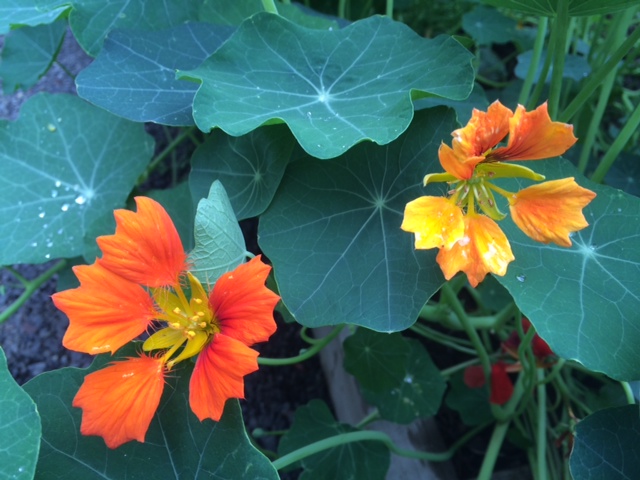
Annual flowers give the summer-long bloom we want to attract hummingbirds.  Some of their favorites are: Calabrachoa, Cleome, Cosmos, Impatiens, Nasturtium, Nicotiana (flowering tobacco), Petunias and Zinnias. 


Growing Asparagus

Standard

photo (119)

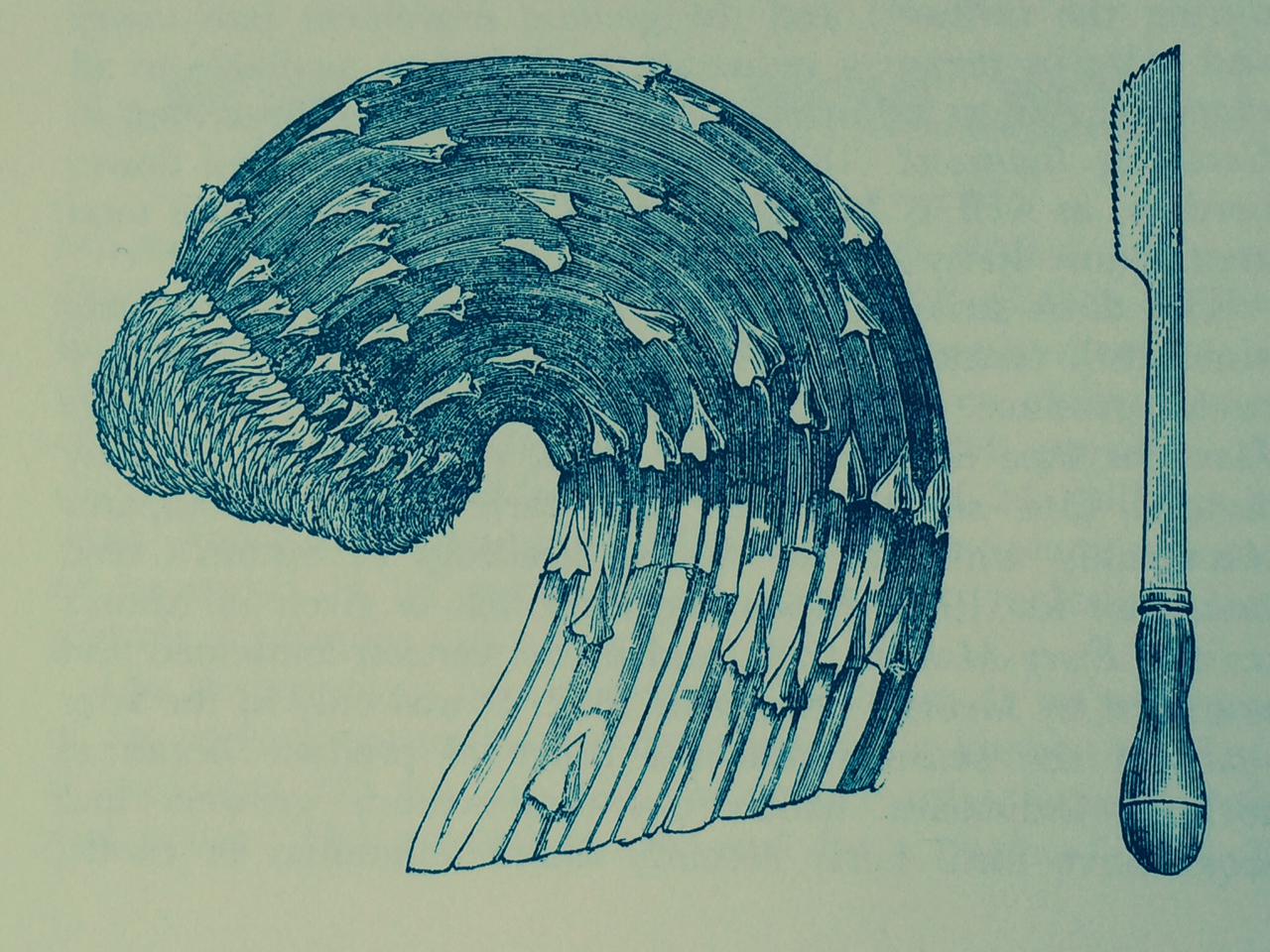
Asparagus (Asparagus officionalis) is a popular vegetable today and was quite popular in the nineteenth century.  The photograph above is of an antique variety, ‘Giant Asparagus’ an engraving from The Illustrated London News, dated 1851.  An asparagus knife is shown alongside the plant.  This year, I grew another old variety of asparagus from seed, ‘Connover’s Collosal’, dating to the second half of the nineteenth century.   It is difficult to find plants of heirloom varieties of asparagus, so one has to start them from seed.  However, the process is slow, as the plants take three to four years to reach the size for harvesting.  (If too many shoots are cut from very young plants, productivity may be reduced, or the plants may die.  But if the plants are allowed to become established, an asparagus bed will last twenty years or more, even up to fifty years!)

Late March into early April is an excellent time to start asparagus from seed.  Use a sterile medium, cover the seed about 1/4 inch deep and place the pots in a warm location (77 degrees is optimum).  The seeds should come up in about ten days.  You may direct seed into a bed if soil temperatures are above 50 degrees, it will just take a little longer for the seeds to germinate.  Asparagus plants begin to grow slowly and will not be ready to transplant out for about three or four months.  Meanwhile you can prepare a bed for them.  An ideal spot is in full sun with a bed large enough to accommodate the number of plants you need.  It is usually recommended to plant five to six plants per person.  Since the plants are perennial (USDA climate zones 4-9) they benefit from a well-prepared bed.  Peter Henderson, in his book Gardening for Profit published in 1867, recommended planting transplants nine inches apart in rows three feet wide for commercial growers, or two feet wide for home gardeners.

Once you have established how many plants you need, you can make the planting bed.  Henderson recommended trenching the bed two to three feet deep with about three inches of rotted manure mixed into the soil.  A deep sandy loam is best for them as they are native to alluvial soils.  Bernard Mc Mahon, in Mc Mahon’s American Gardener, published in 1857, recommended double digging two spades deep and placing several inches of rotted manure in the trench, then spreading another layer of rotted manure over the surface.  He directed gardeners to mix this second layer of manure with the soil to a depth of eight to ten inches.  My young plants, now a year old, have spears a little larger in diameter than a toothpick.  The young plants may be grown in a temporary (sunny) rich bed for another year, then moved to their permanent location.  Place the crowns of the plants two inches below the soil surface.  Keep the beds weeded to ensure quick, even growth.  Mc Mahon recommends three years from planting (which would be four years from sowing seed) before cutting can begin.  Dress the bed every spring with rotted manure, bone meal and wood ashes.

If your family really enjoys asparagus, plant more than five plants per person; I plant twelve per person.  If you plant two-year transplants, spread the roots out like the spokes of a wheel and cover with about one inch of prepared soil.  Water well.  As the plants grow, cover them with more soil until you have them two inches under.  Do not use fresh manure as it will burn them and (heaven forbid) do not use chemical fertilizers, especially on newly planted asparagus.  Wait two years to begin cutting.  A summer mulch of three inches of straw is excellent, will protect the plants in winter and the spears will come up earlier in the spring if the ground is not frozen too deeply.

When you cut asparagus spears get them into the refrigerator right away or cook them immediately because they lose flavor as quickly as sweet corn does.   Considering how expensive asparagus is, I find the start up work well worth while.  Enjoy!

March Gardening Calendar

Standard

photo (118)

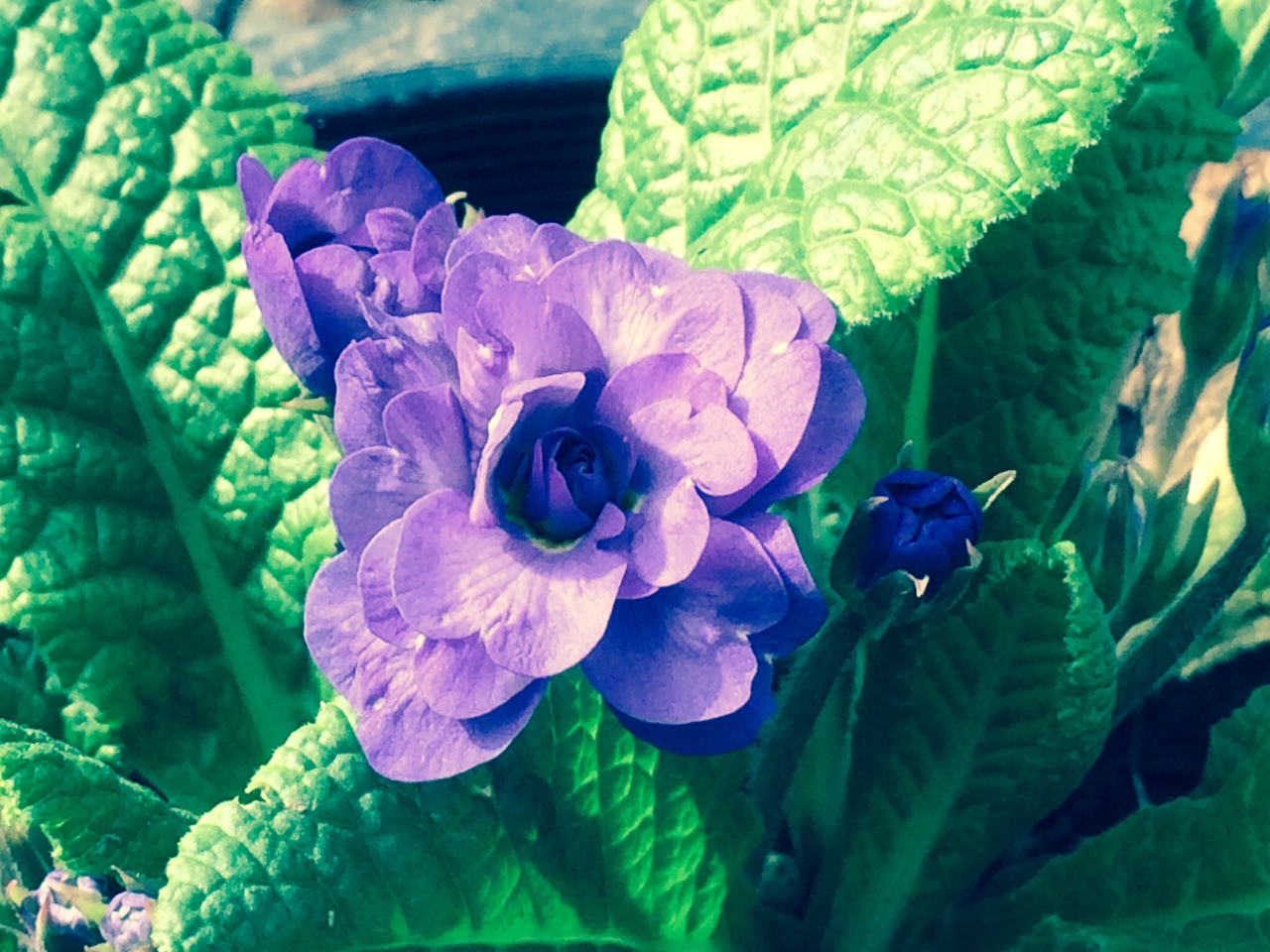
This photo is of a double blue primrose seedling, blooming now in Corvallis, Oregon.

March is a very busy month for gardeners.  Root crops stored from the previous year and planned to produce seed can be planted out late in the month after the soil thaws (cabbages, celery, lettuce, leeks, onions, parsnips).  Planting time will arrive soon, or has already arrived for those of you in mild climates.  Weed and clean borders and vegetable beds, plant perennials, sow seeds of hardy annuals, plant rhubarb, asparagus, sea kale and artichokes.   Plant and/or prune cane fruits and fruit trees (cherries, apples, peaches, apricots, pears, plums, currants, gooseberries, etc.).  Check cold frames on a regular basis, venting as needed and closing the glazing panels at night.  Watch temperatures in the greenhouse also, as March is a month of ups and downs in temperature.  Manure and other organic soil amendments (epsom salts, seaweed meal, alfalfa meal, greensand, bone meal, compost and wood ashes) can be spread over vegetable, fruit, flower and rose beds.  Grape vines can be manured now, leaving space around the stem; treat roses in the same manner.

Many vegetables can be sown indoors now for transplanting out later: cole crops (brassicas), onions, lettuce, peppers, eggplant and leeks.  Some vegetables can be direct sown outside if weather permits and if your soil is not too wet to work: arugula, carrots, corn salad, fava beans, cress, mustard and turnip greens, onions, peas, radishes and spinach.  Celery and lettuce can be direct sown into frames.  Several vegetables and fruits can be transplanted now: raspberries, blackberries, strawberries, asparagus, horseradish, head lettuce, onion sets and plants and perennial herbs.  Make sure your mushroom beds do not get too wet; replace straw if wet.

Potted auricula primroses should be protected from rain and frosts; they will begin to bud soon.  Sow any remaining auricula and primrose seeds.  Herbaceous perennials can be divided and planted now.  Many hardy annual flowers may be sown during March: larkspur, sweet peas, lychnis, nigella, lavatera, poppies, kiss-me-by-the-garden-gate and sweet alyssum.  Inside the greenhouse sow: petunias, impatiens, pansies, alyssum, chrysanthemums, iceplants, portulacas, salvias, snapdragons, sweet Williams, ten-week stocks, mignonette, hesperis, Shasta daisies, hibiscus, lupine and Salvia x superba.

Roses and other shrubs may be layered now, and cuttings may be made of geraniums, myrtles and hydrangeas.  If you want to plant a hedge from seed, now is the time to sow seeds of hawthorns, stone fruits, roses and other hardy shrubs you might like to use.  The young plants can be transplanted out to their permanent positions later.

Happy Spring!


Designing A Garden For Heirloom Plants

Standard

photo (92) photo (93) photo (94) photo (95) photo (96) photo (97) photo (98) photo (99)

Winter is an excellent time for gardeners to plan garden designs as there is minimal activity outside this time of year, epecially in northern climates.  As soon as soil can be worked you can begin executing your project.  In southern and low desert climates it is also a good time to plan your garden and build it because the cool temperatures make it easier to do heavy physical labor.

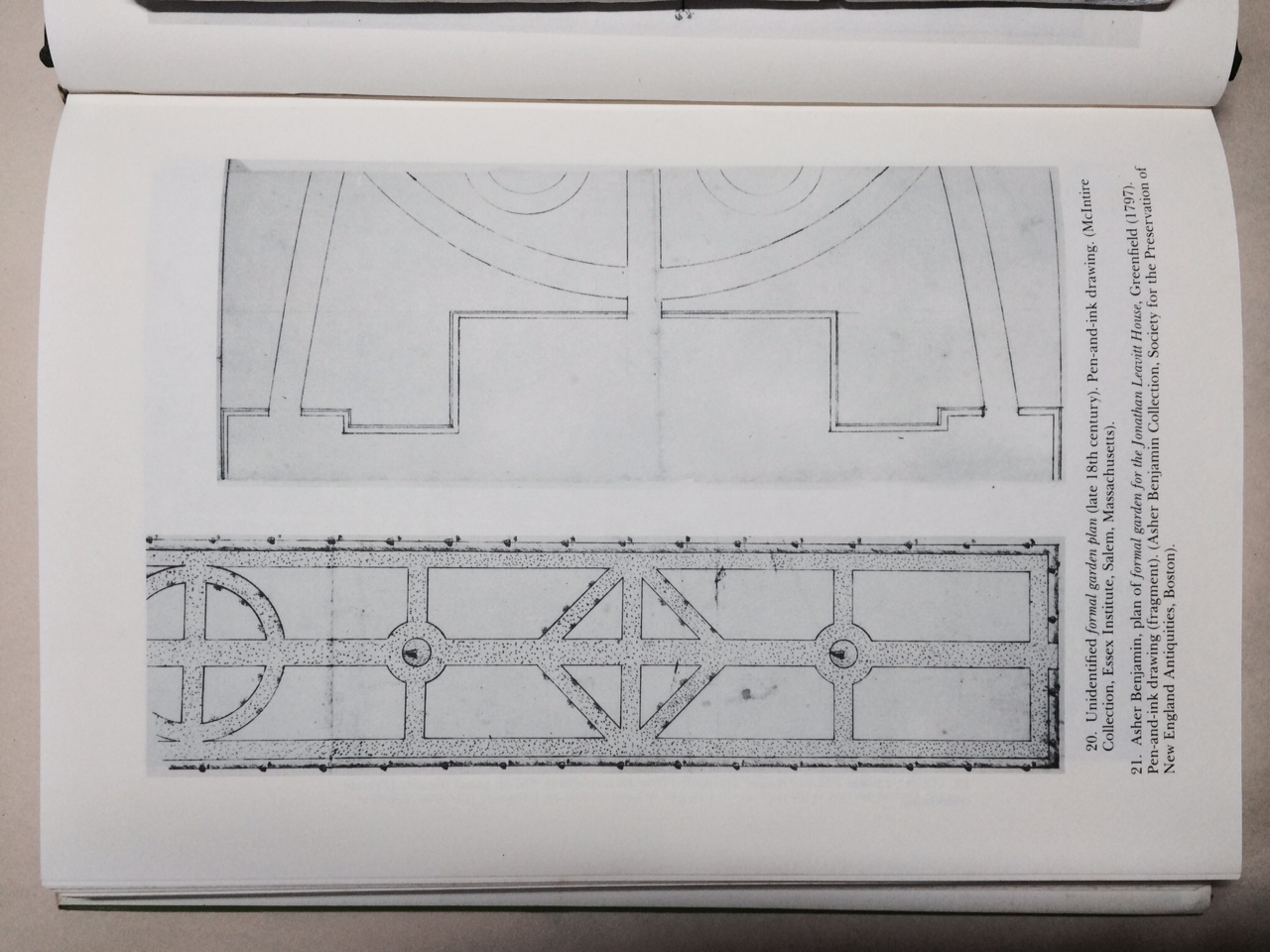
This last year I designed and built a garden in Early American style to hold my collection of antique roses, fruits, flowers and vegetables.  I had several goals: create a design based on historic models; maximize use of space and efficiency; minimize maintenance labor; use local materials, protect plants from predation and create the best growing conditions possible.  The first picture above depicts an American garden design plan from the late eighteenth century.  The original drawing is archived at the Essex Institute in Salem, MA.  My photo is taken from British and American Gardens of the Eighteenth Century, edited by Robert P. Maccubin and Peter Martin; The Colonial Williamsburg Press, 1984.  This style of design and use of space has its roots in Medieval gardens of Europe.  The plan is formal; beds are edged by timbers, are often raised or slightly raised and mud-free (and/or weed-free) paths separate beds.  This formal style is quite convenient to tend: crops can be separated and rotated; soil pH, texture and drainage can be adjusted from bed to bed, and some beds can be high water-use, while others may be medium or low water-use.  I find it convenient to place high water-use beds nearest the house and low water-use beds farthest away.

The second photo above is of my garden design for my garden in Corvallis, Oregon.  I measured the entire site, then made the drawing to scale on graph paper.  I used cut-out pieces of colored paper for structures such as the greenhouse, cold frames and porches.  I made labeled pieces of graph paper to indicate trees and shrubs.  The cut-out pieces can be moved around over the drawing until you determine where you want everything to go.  Shade is an issue in this garden, so sun-loving and shade tolerant plants were placed accordingly.

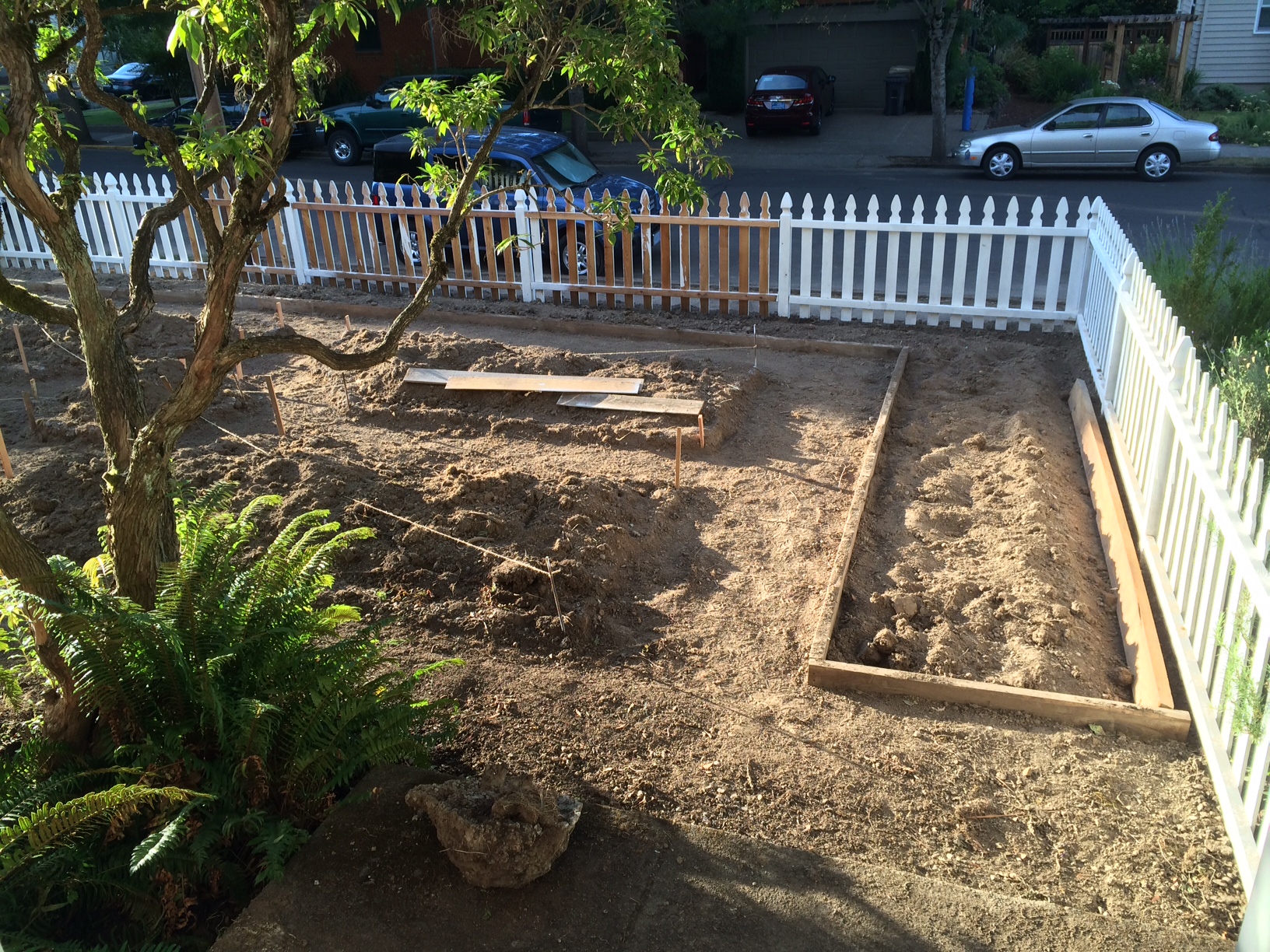
When the design was finished, trees and shrubs that cast heavy shade were removed or moved to new location; materials and workmen were sourced.  Tree and shrub roots were ground and removed.  Soil leveling was undertaken, then fences were built.  We tilled the soil, as seen in the third photo above, then raked the grass and roots into piles approximating the location of beds.  We had such a hot summer that the grass roots quickly died.  They provided immediate organic material for the soil.

We measured and drew out my design with spray paint and began to build our boxed beds.  I used 2′ x 12′ cedar lumber anchored in place with metal spikes set in concrete.  The fourth photo shows bed construction in the back yard garden.  Trenches 6 inches deep were dug to lay the timbers into.  Now we had beds raised six inches above the original soil level and 4 inches above planned level of the gravel.  This enabled us to use the native soil and amend it with 4 to 5 inches of compost, manure, greensand, wood ashes, alfalfa meal and bone meal (See the fifth photo above of the front garden).

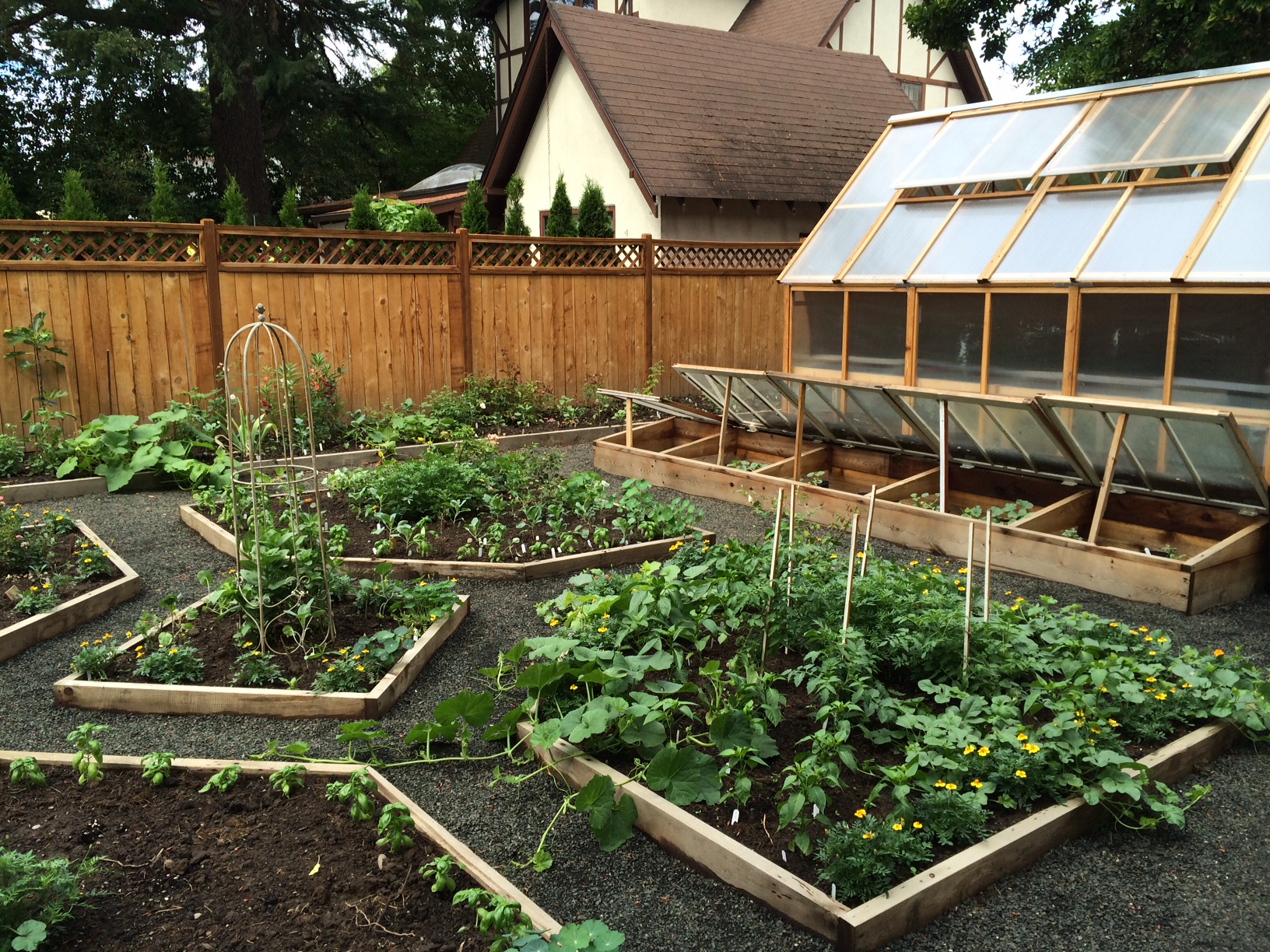
After soil preparation, planting could begin.  The sixth photo above is a shot of the back garden two weeks after planting.  Vegetables grew quickly in the wonderful, organically amended soil.  The front garden was finished and planted a few weeks later (the seventh photo above).  The front beds were planned for bulbs, perennials and shrubs that use little or no additional water in our climate.  I do have to water the rose bed bordering the fence; watering deeply but infrequently once the roses are established.

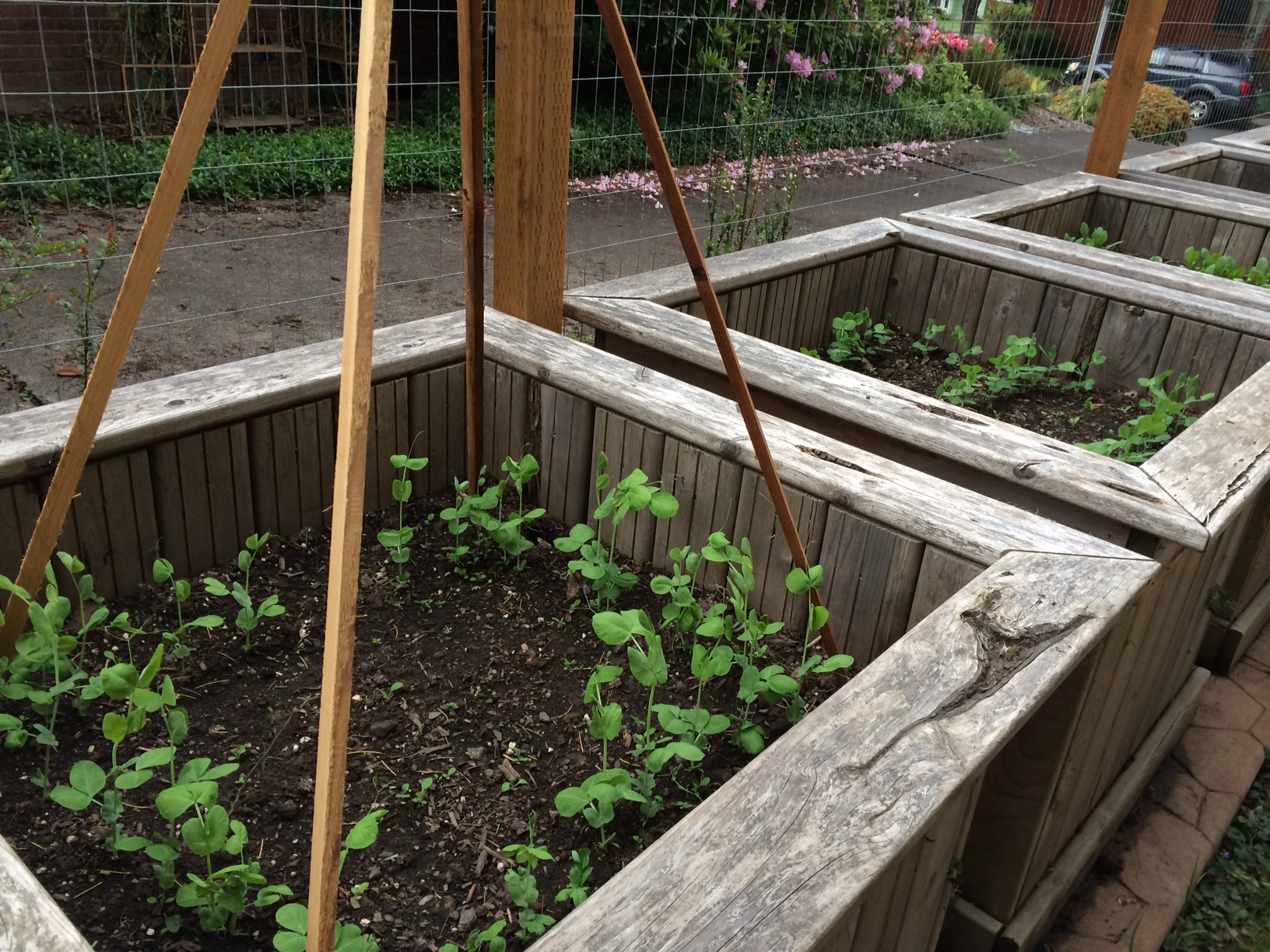
The last photo shows one of the large 3′ x 3′ wooden tubs newly planted with ‘Blue-Podded Blauwschokker’ peas, which date to the sixteenth century.

The entire construction project took six months, from design to planting.  For a labor force we had two people working part time and one person working full time.  The garden is planted with heirloom plants dating from the ancient Greco-Roman period through the Oregon Trail Era (1830-1869).  Also included are a few more recent varieties, dating before and up to 1925, when the house was built.


January Gardening Calendar

Standard

photo (84)

On or near the beginning of each month I will present a gardening calendar.  I find that it saves time and worry if I have a ready-made plan for activities in the garden.  January is one of the least busy months of the year for gardeners, but we have a few things that need to be or can be done:

Plan your garden for the year.  Read seed and nursery catalogs and pick out what you would like to grow.  It is a good idea to plant greater numbers of the vegetables and fruits your family uses on a regular basis.  Minimize or eliminate the things you do not.  Figure out how much space you have and how much seed you need, then order.  If you are just beginning or reconfiguring your garden, January is a great time to undertake design projects.  January is also an excellent time to repair equipment, such as garden tools, plant supports and cold frames.

If you have a supply of fresh manure you can make a hotbed in which to grow early vegetables and flowers.  Though perhaps unpleasant to deal with, a hotbed provides a little microclimate that is much warmer and more humid than the out of doors.  Hotbeds will extend your growing and harvest seasons.  They are a real help in climates with short seasons and cool nights.  Squash, melons, peppers and eggplant enjoy the warm nights a hotbed will provide, thereby significantly increasing production.  In the nineteenth century most winter vegetables, such as cauliflower, were grown in hotbeds.

Carefully tend your cold frames in January, covering them with insulating materials on cold nights and admitting air during the day if it is not too cold.  Now is the time to clean debris and dead leaves out of winter lettuces and other greens in cold frames or cold greenhouses.

Early cabbage can be sown indoors, as well as parsley, cauliflower and eggplant.  Flowers to sow inside to transplant out later include: geraniums, impatiens, lobelia, petunias, pansies, snapdragons and violas.  Primroses, auriculas, delphinium and many other perennials can be sown now indoors.

Manure can be spread over vegetable beds and perennial borders.  Pruning can begin of fruit trees and raspberries.  If you live in a mild climate or have a large cold frame or cold greenhouse, you can harvest any of the following: leeks, spinach, kale, carrots, lettuce, corn salad, onions, parsnips and chard.  In a cold climate carrots and parsnips outside can be covered with straw to protect them, so you just have to push away the snow and straw to dig them.  In a cold (unheated) greenhouse greens can be grown and harvested all winter, especially if an inner layer of floating row cover is placed over the crops to protect them.  Stakes or hoops will prevent the fabric from touching the leaves of the plants.

Enjoy January!